
OFS06B-1 vs. OFS06A-5: Which Infrared Sauna Room Fits Your Commercial Project?
Two OCEAN FUTURE infrared sauna rooms sit at opposite ends of the same electrical range. The OFS06B-1 is rated at 1,850 W. The OFS06A-5 is rated at 3,000 W. Both are built for commercial and premium residential interiors — hotels, guesthouses, wellness clubs and private wellness rooms — and both come from the same modular sauna platform. They are not interchangeable, and the difference between them is a sizing decision, not a quality ranking.
For most projects the answer appears as soon as two variables are known: how big the cabin is, and how often it has to be ready for the next guest.
Quick answer. Choose the OFS06B-1 (1,850 W) when the cabin is compact, the daily session count is low, and the building has limited spare electrical capacity. Choose the OFS06A-5 (3,000 W) when the cabin is larger, sessions turn over quickly, or the room is a guest-facing amenity that must run on a schedule. Then confirm three things on the quotation for either model: the wood species, the audio and control option, and the destination-market compliance documents.
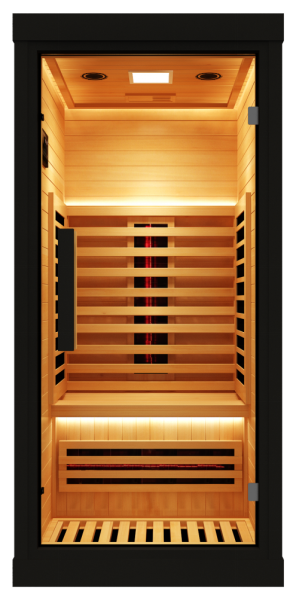
OFS06B-1 — the compact 1,850 W option in the OCEAN FUTURE infrared sauna range.
The wattage line is the most misread number in a sauna quotation
Commercial buyers rarely make mistakes on the visible items. Wood grade gets discussed, the glass door gets discussed, the price gets negotiated. The electrical specification is treated as a technical footnote — and that is exactly where projects stall.
Rated power decides four things at the same time: how quickly the cabin reaches its setpoint, how quickly it can be used again after a session, how much connected load the building has to carry, and whether the room still performs as promised six months after handover. Two failure modes repeat in hotel and guesthouse projects:
- Undersizing a large or busy room. A lower-wattage unit in a cabin that is too large runs at full output for a long time, may struggle to reach the intended temperature, and turns a paid amenity into a complaint.
- Oversizing without checking the supply. A higher-wattage unit helps only if the building can feed it. If the distribution board or the cable run cannot carry the load, the upgrade cost lands on the project rather than on the sauna supplier.
The practical consequence for a procurement team is an order of operations: settle cabin size and usage pattern first, size the power second, verify the electrical supply third, and only then negotiate wood, features and price.
Commercial sauna demand is growing — and getting more documentation-heavy
Sauna is no longer a niche residential purchase. Technavio valued the US sauna market at USD 437.4 million in 2025 and forecasts a 6.5% CAGR across 2026–2030. Market.us projects roughly 6.1% CAGR for the global market over 2023–2033. Harvia, the sector’s publicly listed operator, estimates the global sauna market at close to EUR 4 billion, with around 18 million saunas installed worldwide. Publishers disagree on absolute values because scopes and methodologies differ, but the direction is consistent.
Two standards changes matter more to project buyers than the growth rate itself:
- EN 18164, published in February 2026, is described as Europe’s first pan-continental standard covering the design and construction of sauna rooms, warm-air rooms, steam rooms and soft steam rooms in public facilities.
- UL 60335-2-53, published in June 2025, addresses electric sauna heaters in the US market.
Read together, they send one clear procurement signal: room construction and heater compliance are separate objects. A project can satisfy one and still be missing documentation on the other — a risk that has nothing to do with which of the two models you prefer.
Matching the two models to the project
What 1,850 W actually buys you: OFS06B-1
The B-series rating is a good fit where cabin volume is modest and the daily duty cycle is light. Because the connected load is lower, retrofit projects usually find it easier to place on existing building supply — a factor that often decides the model before price is even discussed. For a small guesthouse, a bed-and-breakfast, or a private wellness room used a few times a day, the lower rating is not a compromise; it is the correct match.
The limit is equally clear. In a large cabin, or in a room that must be ready every 30 to 40 minutes through an evening, the same unit works harder than it should. Guests notice long heat-up times before they notice anything else.
What 3,000 W actually buys you: OFS06A-5
The A-series rating buys headroom. More power in the same time window means a faster approach to setpoint, a quicker recovery after the door has been opened, and shorter intervals between guest sessions. That is what boutique hotel spas, wellness clubs and higher-turnover commercial amenities are paying for.
The trade-off is on the building side, not the sauna side. Before confirming the OFS06A-5, the project should verify available capacity, cable routing and the distance from the distribution board. On a new-build this is a drawing exercise; on a retrofit it can be a cost line.
The energy question is power multiplied by time
Higher wattage is not automatically higher energy consumption per session, and lower wattage is not automatically more efficient. Energy use per session is roughly rated power multiplied by the time the elements are actually running to reach and hold setpoint.
A 3,000 W unit that brings a large cabin to temperature quickly can consume a comparable amount of energy to a 1,850 W unit working longer in the same space. A 1,850 W unit placed in a cabin that is too large is the worst of both worlds: it runs at full output for longer, and it may still not reach the intended temperature. The efficient choice is the matched choice. OCEAN FUTURE also positions its modular platform as more energy-efficient than traditional sauna heaters, with a simple cleaning routine that reduces long-term maintenance needs.
Wood specification is a separate decision from power
Wood does not change the electrical sizing, but it changes price positioning, appearance and how the cabin ages in a humid or semi-exposed installation. Three species dominate commercial discussions:
- Canadian Red Cedar — the premium end of the range: rot-resistant and aromatic, typically specified where the cabin is a visible design feature or where humidity exposure is higher.
- Canadian Hemlock — budget-premium: neutral scent and stable behaviour, often chosen where the room is serviceable and cost positioning matters.
- Aspen — the budget option and a traditional Finnish choice, valued for heat resistance.
For European commercial work, timber sourcing documentation is increasingly requested alongside the electrical file, so it is worth confirming species and chain-of-custody paperwork at quotation stage rather than at delivery.
The features that separate a hotel spa room from a guesthouse room
Audio and control are usually the second question after power, and they are not automatically included. For a small guesthouse, fewer features and simpler controls mean fewer failure points and lower maintenance demand. For a hotel spa, guests expect ambient audio and a control interface that housekeeping and front-desk staff can operate consistently across rooms. Confirm on the quotation whether an audio or speaker option is part of the specified configuration, and how it integrates with the room control.
For outdoor or semi-outdoor installations, the enclosure specification matters more than the wattage. OCEAN FUTURE describes an aluminium-plastic composite panel casing that is water- and UV-resistant, a sealed structure, and overheat protection as the control method against overheating and moisture damage, supported by pre-delivery environmental safety testing, corrosion-resistant hardware and quality inspection.
Cabin production at OCEAN FUTURE — the same platform carries both the 1,850 W and 3,000 W configurations.
A seven-step selection sequence for commercial buyers
1. Size the cabin, not the room. Volume and intended occupancy drive everything downstream. A dressing area next to the cabin is not part of the heated zone.
2. Map the duty cycle. Count sessions per day, the interval between guests, and the hours the room must stay available. Two high-turnover sessions an evening is a different requirement from eight booked slots.
3. Check the electrical supply. Available capacity, cable run and distance from the distribution board. This is the step that turns a model preference into a fixed decision.
4. Choose the rating. Compact cabin and light schedule: OFS06B-1 at 1,850 W. Larger cabin or schedule-driven operation: OFS06A-5 at 3,000 W. Mixed sites can use both.
5. Specify the wood. Cedar, hemlock or aspen, matched to environment, budget and how visible the cabin will be.
6. Confirm comfort and control features. Audio and control options, plus the enclosure specification for outdoor placement.
7. Align documentation and supply terms. Room-level and heater-level compliance documents for the destination market, plus MOQ, lead time and delivery terms, agreed before the purchase order is issued.
Four project profiles
Small guesthouse, two to six rooms
A compact cabin with a light, unbooked schedule is the clearest case for the OFS06B-1. Lower connected load keeps retrofit electrical work minimal, and the lower rating matches the actual demand rather than an imagined peak.
Boutique hotel spa
When treatment slots are sold by the hour, the room must be ready on time, every time. The OFS06A-5 at 3,000 W is the specification that protects the schedule, particularly where the cabin is larger or the door opens frequently.
Wellness club or commercial club
High turnover across multiple cabins is a portfolio decision as much as a product decision. Standardising on one configuration per room tier keeps controls, service procedure and spare parts consistent — and a mixed deployment of both ratings is normal where cabins differ in size.
Premium residential and semi-outdoor cabins
For a private wellness room the decision usually follows cabin scale: smaller cabins suit the 1,850 W unit, larger rooms the 3,000 W unit. As soon as the cabin moves outdoors or into a humid space, the enclosure specification, the sealed structure and the wood species become the deciding variables rather than the wattage alone.
Side-by-side comparison
| Decision factor | OFS06B-1 (1,850 W) | OFS06A-5 (3,000 W) |
|---|---|---|
| Rated power | 1,850 W | 3,000 W |
| Best-fit cabin scale | Compact cabins with modest occupancy | Larger, higher-occupancy cabins |
| Heat-up behaviour | Approaches setpoint more slowly — suitable where sessions are spaced out | Faster approach to setpoint — suitable where sessions are scheduled |
| Recovery between sessions | Longer interval recommended between guests | Shorter interval achievable, better door-open recovery |
| Connected electrical load | Lower — easier on existing building supply | Higher — verify capacity and cable run before ordering |
| Energy profile | Efficient when matched to a compact cabin | Efficient when matched to a large cabin; avoid oversizing a small room |
| Typical project | Small guesthouse, B&B, residential wellness room | Hotel spa, wellness club, schedule-driven commercial amenity |
| Wood specification | Selected at quotation stage — species confirmed per project | Selected at quotation stage — species confirmed per project |
| Audio and control options | Confirm inclusion on the quotation | Confirm inclusion on the quotation |
| Maintenance profile | Lower load, simple cleaning routine | Higher duty cycle — plan service access and spares |
Comparison based on manufacturer-stated rated power and platform documentation. Both models share the same modular construction, dual heating options (traditional or infrared), overheat protection and water- and UV-resistant casing described for the OCEAN FUTURE sauna platform.
What the choice means after handover
A head-to-head decision does not end at commissioning. For groups operating more than one property, the model choice becomes a standardisation decision: the same configuration across comparable rooms keeps staff training, maintenance procedures and spare-part stock simple. That is the point where supplier capability matters as much as the unit itself.
OCEAN FUTURE is a sauna room and spa product manufacturer and supplier working from a 50,000 m² factory with more than 200 employees and a nine-engineer R&D team. The company states a monthly production capacity of 400 sets and reports that around 85% of output is exported, with the USA, Australia, the EU and Germany as main markets. It also states that it offers indoor, outdoor, infrared and traditional Finnish sauna rooms with OEM support.
Commercial terms are relevant to the same long-term view: minimum order quantity from 1 set, a stated lead time of 30–40 days, delivery arranged on EXW, FOB, CFR, CIF, DAP or DDP terms, acceptance based on a pre-shipment test, and payment at T/T 30% deposit with 70% balance before shipment. A platform that reports assembly time reduced by 70% and heating speed up by 40% compared with traditional fixed and single-mode cabins, at an initial cost around 10% lower than custom-built saunas and a total cost of ownership nearly 30% lower over five years, is easiest to justify when it is rolled out as a standard rather than as a one-off.
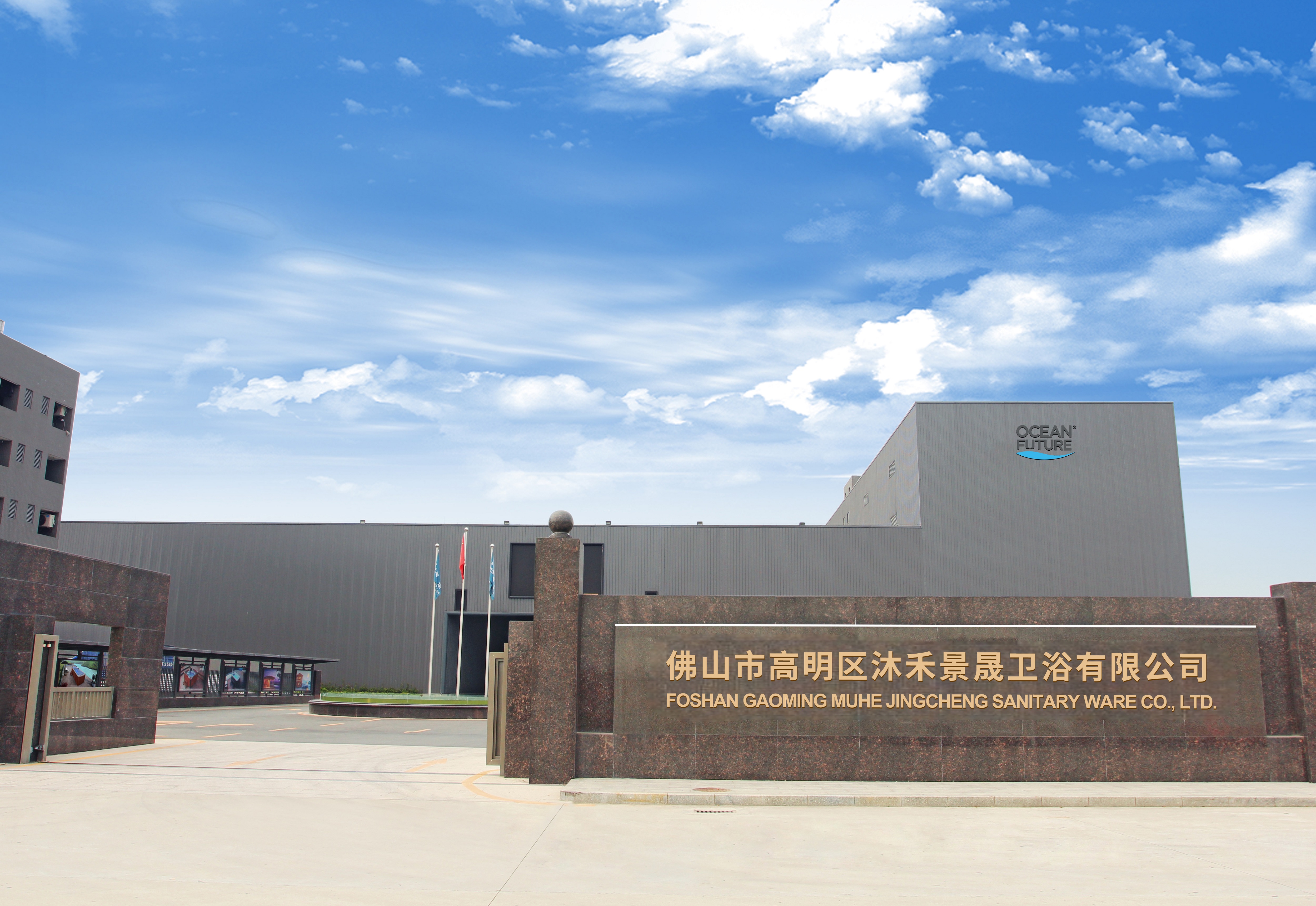
OCEAN FUTURE’s Foshan facility supports repeat-order supply and OEM sauna room programmes.
Frequently asked questions
Does the choice between OFS06B-1 and OFS06A-5 change which safety standards a hotel project must document?
No. The obligation is the same; only the power rating printed on the paperwork changes. EN 18164, published in February 2026, covers the design and construction of sauna rooms, warm-air rooms, steam rooms and soft steam rooms in public facilities in Europe. UL 60335-2-53, published in June 2025, addresses electric sauna heaters in the US. Because room construction and heater compliance are separate objects, a project needs documentation at both levels whichever model is selected. The practical step is to list the destination market, confirm the room-level and heater-level requirements separately, and request documents that name the exact model.
Can one model cover both a small guesthouse room and a hotel spa?
Rarely as an optimum. The 1,850 W OFS06B-1 fits compact cabins with light schedules, while the 3,000 W OFS06A-5 fits larger cabins and schedule-driven operation. Multi-property operators usually standardise on one configuration per room tier, sourced from the same platform so that controls, service routines and spares stay consistent across the portfolio. OCEAN FUTURE states that it offers indoor, outdoor, infrared and traditional Finnish sauna rooms with OEM support, which allows a group to keep one supplier relationship across different room types.
How should the two models be compared commercially?
Compare total cost of ownership rather than unit price. OCEAN FUTURE’s positioning data for its modular sauna platform states an initial cost about 10% lower than custom-built sauna rooms and a total cost of ownership nearly 30% lower over five years. On top of the unit itself, add the electrical side: the 3,000 W unit may require supply work that the 1,850 W unit does not, and that difference belongs in the project budget, not in the sauna quotation. Commercial terms are MOQ from 1 set, with payment at T/T 30% deposit and 70% balance before shipment.
Can I validate a single unit before committing to a full project order?
Yes. The stated minimum order quantity is 1 set, and the stated acceptance criterion is a pre-shipment test. OCEAN FUTURE also describes pre-delivery environmental safety testing, corrosion-resistant hardware and quality inspection as standard measures. Specify the exact model, the rated power and the wood species on the trial order so that what you validate is what you later roll out across the property.
What lead time and capacity should I plan for a multi-property rollout?
The company states a lead time of 30–40 days and a monthly production capacity of 400 sets, produced in a 50,000 m² factory with more than 200 employees and a nine-engineer R&D team; around 85% of output is exported, with the USA, Australia, the EU and Germany as main markets. Delivery can be arranged on EXW, FOB, CFR, CIF, DAP or DDP terms. The next practical step is to send the project brief — cabin size, daily session pattern, destination market and preferred wood species — and request a model recommendation together with a sample or quotation for the configuration you intend to standardise on.
Conclusion: match the load to the room, then commit
The OFS06B-1 and the OFS06A-5 answer two different commercial questions. At 1,850 W, the B-series is the matched specification for compact guesthouse cabins, low session counts and retrofit buildings where spare electrical capacity is limited. At 3,000 W, the A-series is the matched specification for larger cabins, scheduled hotel spa sessions and any amenity where the room must be ready again quickly.
Neither is an upgrade of the other. The right answer comes from cabin volume, duty cycle and available supply — then from wood species, audio and control options, compliance documents for the destination market, and a supplier who can repeat the same configuration across properties and years. Start with the load, and the model chooses itself.
Planning a hotel, guesthouse or wellness project? Send your cabin size, expected daily sessions and destination market, and the OCEAN FUTURE team will recommend the right rating between the OFS06B-1 and the OFS06A-5, confirm the wood specification option, and quote sample or project quantities.
Contact: Kinear · Email: service1@oceanfuture.cn · Tel / WhatsApp: +86 15820624699 · NO.568, Yangxi Road, Yanghe Town, Gaoming, Foshan, Guangdong, China.
Download the full OCEAN FUTURE Sauna Room catalogue (PDF), or explore the infrared sauna room range and the OCEAN FUTURE blog for further project guidance.

From compact guesthouse cabins to schedule-driven hotel spa rooms — OCEAN FUTURE builds both ends of the range on one modular platform.
Have Questions or Need More Details?
Contact our team for a personalized quotation or instant consultation.
Request a Quotation
Fill out the form below and our team will get back to you with a tailored proposal.
WhatsApp Direct Chat
Prefer to chat in real-time? Message us on WhatsApp for instant assistance & quick answers.
- Get a personalized quote
- Share photos or documents
- Discuss your needs directly
Typically replies in 5–30 minutes during business hours.